Quick Comparison: Everyday Dress Fabrics at a Glance
The best everyday dress fabrics balance breathability, durability, and low maintenance; the right pick depends on your climate, schedule, and skin. Cotton and jersey knits handle most daily wear, linen and rayon win in heat, and polycotton blends survive busy mornings.
Fabric
Breathability
Care Level
Best For
Cotton / jersey knit
High
Easy
Daily wear, casual
Linen
Very high
Moderate
Hot weather
Rayon / viscose
High
Delicate
Warm days, drape
Polycotton blend
Medium
Very easy
Durability, workwear
Silk / satin
Medium
Delicate
Dressed-up looks
How to Judge Fiber Content, Weave, and GSM Before You Buy
Fiber content tells you what a dress is made of; weave structure tells you how it behaves. Two dresses can both read "100% cotton" and feel completely different because one is a tight poplin and the other a loose gauze.
Reading a Fabric Label Without the Guesswork
Fiber content: Listed by percentage, highest first. A 50/50 cotton-poly blend splits the difference between softness and crease resistance.
Weave structure: Plain weaves feel crisp; knits stretch and drape. Woven fabrics generally wrinkle more but hold shape longer.
GSM: Under 150 GSM reads lightweight and airy; 150-250 GSM is midweight and opaque; above 250 GSM is heavy and structured.
Stretch factor: Any spandex content adds give and shape retention, which matters for fitted silhouettes.
Pro TipHold the fabric up to a light source before buying. If you can see your hand clearly through it, expect to layer or size up for opacity.
Cotton and Jersey Knits: The Everyday Workhorses
Cotton is the backbone of everyday dress fabrics, and jersey knits are its most comfortable form. Cotton breathes, resists pilling when staple length is decent, and washes without drama.
Breathable Fabrics for Summer Dresses That Actually Keep You Cool
The most breathable fabrics for summer dresses are linen, rayon, and viscose, because their cellulose fibers wick moisture and release heat instead of trapping it. Cotton ranks close behind. Polyester, worn alone in high heat, does not.
Linen, Rayon, and Viscose in Real Heat
Linen moves air through its loose weave and dries quickly, though it creases by design. Rayon and viscose drape beautifully and feel cool against skin, but lose tensile strength when wet, so treat them gently.
Low Maintenance Dress Fabrics for Busy Mornings
Low maintenance dress fabrics resist creasing, hold their color, and survive a normal wash cycle without special handling. Polycotton blends and knit synthetics lead here, followed by cotton blends with a small amount of spandex. But "low maintenance" is the sum of four fiber behaviors: wrinkle recovery, colorfastness, pilling resistance, and shape retention. A fabric can excel at one and fail another, which is why a dress that looks crisp out of the dryer can still pill under the arms within a month.
What Actually Causes Pilling, Fading, and Shape Loss
Pilling is a mechanical process: short fibers work loose from the yarn surface, tangle with friction, and ball up. Three variables control it: staple length, yarn twist, and knit or weave tightness.
Staple length: Long-staple cotton (often labeled Pima or Supima) and long-staple rayon have fewer fiber ends available to migrate out of the yarn, so they pill far less than short-staple versions of the same fiber.
Yarn twist: Higher twist per inch locks fibers into the yarn. Low-twist yarns feel softer in the hand but shed fibers faster.
Fabric tightness: A tight plain weave or a dense interlock knit traps fibers better than a loose single jersey. This is why a cheap 100% cotton tee pills while a tightly woven cotton poplin shirt does not.
A 50-Wash Reality Check by Fiber
Most practitioners find that the following patterns hold across repeated home laundering:
100% cotton jersey: Softens and may shrink 3-5% in the first few washes if not pre-shrunk. Pilling depends entirely on staple length. Color fades gradually.
Polycotton (50/50 or 60/40): Best all-around balance for busy mornings. Minimal shrinkage, strong colorfastness, moderate pilling resistance if the cotton component is long-staple.
100% polyester knit: Excellent color and shape retention, but can develop a slight sheen and hold odors. Pilling is rare because polyester fibers are strong and resist breaking.
Rayon and viscose: Beautiful drape that degrades fastest. Wet strength is roughly half of dry strength, so agitation in the wash causes gradual thinning and loss of body.
Linen: Gets softer and more comfortable with every wash, but creases more, not less, over time. Color holds well if washed cold.
Key TakeawayThe single highest-leverage care habit for everyday dresses is washing cold and skipping the dryer. Heat is what drives shrinkage, dye release, and spandex breakdown. A dress washed cold and hung to dry will typically outlast the same dress washed warm and tumble-dried by a wide margin.
Sensory-Friendly and Sensitive-Skin Considerations
Cotton and viscose feel smoothest against sensitive skin, while rougher wool blends and stiff polyesters can irritate. Two factors matter more than most guides admit:
Seam construction: A flatlock or coverstitch seam lies flat against the skin. A standard serged seam with exposed thread creates a ridge that bothers sensitive wearers regardless of fiber.
Fabric finish: Some polyesters are treated with finishes that feel slick and cool, while others feel clammy. Viscose and modal tend to feel cool and smooth without a finish.
How to Care for Cotton and Linen Dresses So They Last
Wash cotton and linen dresses in cold water on a gentle cycle, then air dry or tumble on low. Heat causes shrinkage, fading, and fiber breakdown, so cold water and low heat do most of the work.
Linen: Wash less often, use a gentle cycle, and hang to dry; press while slightly damp.
Rayon and viscose: Hand wash or use a delicate bag, never wring, and dry flat to protect the drape.
Blends with spandex: Skip the dryer; heat breaks down stretch and shortens the dress's life.
Watch OutWashing rayon or viscose in hot water can shrink the garment and weaken the fibers permanently. Once that happens, no amount of stretching brings the dress back.
Matching Fabric to Body Type, Skin Sensitivity, and Budget
Fabric choice changes how a dress reads on your body. Structured fabrics like midweight cotton and denim hold a defined silhouette, while fluid fabrics like rayon and viscose skim and soften. The more useful question is which fabric works with which silhouette, because the same fabric can flatter in one cut and fight you in another.
Fabric and Silhouette Pairings That Actually Work
A-line dresses: Almost any fabric works, but midweight cotton, linen blends, and ponte knit hold the A shape without collapsing. Very light rayon can make an A-line read as a sack because it has no body to push the flare outward.
Wrap dresses: Need fabric with drape and a bit of recovery. Jersey knit, ITY (interlock twist yarn) polyester, and rayon blends tie cleanly and hold the wrap without gaping. Stiff poplin and heavy linen resist the tie and create bulk at the waist.
Shift and sheath dresses: Best in fabrics with enough weight to hang straight. Midweight ponte, double-knit, and structured cotton twill skim the body. Thin single jersey clings to every line.
Tiered and babydoll dresses: Designed for lightweight wovens and gauze. Cotton voile, rayon challis, and lightweight linen let the tiers fall in soft folds. Heavy fabrics make tiers look bulky.
Bias-cut dresses: Require fluid, stretchy fabrics. Rayon, silk charmeuse, and jersey drape and recover. Woven cotton on the bias wrinkles across the body and loses shape.
Bodycon dresses: Need high spandex content (typically 5-10%) and a dense knit. A 95/5 polyester-spandex or nylon-spandex blend holds the body without sheerness.
Body Type and Fabric Weight
Fabric weight and body type interact more than fiber name alone.
Curvier silhouettes: Midweight knits (200-250 GSM) and woven tiers flatter without clinging. Very light fabrics (under 150 GSM) can highlight every contour, while very heavy fabrics (over 300 GSM) add visual bulk.
Petite frames: Lighter GSM fabrics and tiered hems avoid overwhelming the frame. Heavy structured fabrics can swallow a petite silhouette.
Tall frames: Can carry heavier weights and larger-scale prints. Lightweight fabrics may feel insubstantial.
Straight or athletic builds: Fabrics with drape and movement (rayon, viscose, silk blends) create curves visually. Stiff fabrics emphasize a straight line.
Skin Sensitivity
Sensitive skin: Cotton, viscose, lyocell, and silk feel smoothest. Rough wools and stiff polyesters can itch. Look for flatlock seams and avoid heavily finished synthetics.
Allergy-prone skin: 100% cotton and lyocell are the most commonly recommended because they are breathable and free of the residual chemicals that sometimes remain on cheap synthetic knits.
Budget vs. Luxury: What the Extra Money Actually Buys
Higher price usually buys longer staple fibers and tighter weave, meaning less pilling and better colorfastness. A well-made cotton dress outlasts three cheap ones. Understanding the mechanism helps you spot value without paying for a label.
Long-staple vs. short-staple cotton: Pima and Supima cotton have fibers roughly 1.5 inches long versus about 0.75 inches for standard upland cotton. Longer fibers mean fewer ends to pill and a smoother, stronger yarn.
Yarn count and ply: Two-ply yarns are twisted from two single yarns, which makes them stronger and more pill-resistant than single-ply yarns of the same fiber.
Weave density: A tightly woven poplin at 120 threads per inch resists pilling and holds shape far better than a loose 60-thread weave, even when both are 100% cotton.
Dye method: Piece-dyed and yarn-dyed fabrics generally hold color better than garment-dyed or surface-printed fabrics, which fade faster with washing.
Everyday Dress Fabrics Worth Buying at OG Gilmore Girl
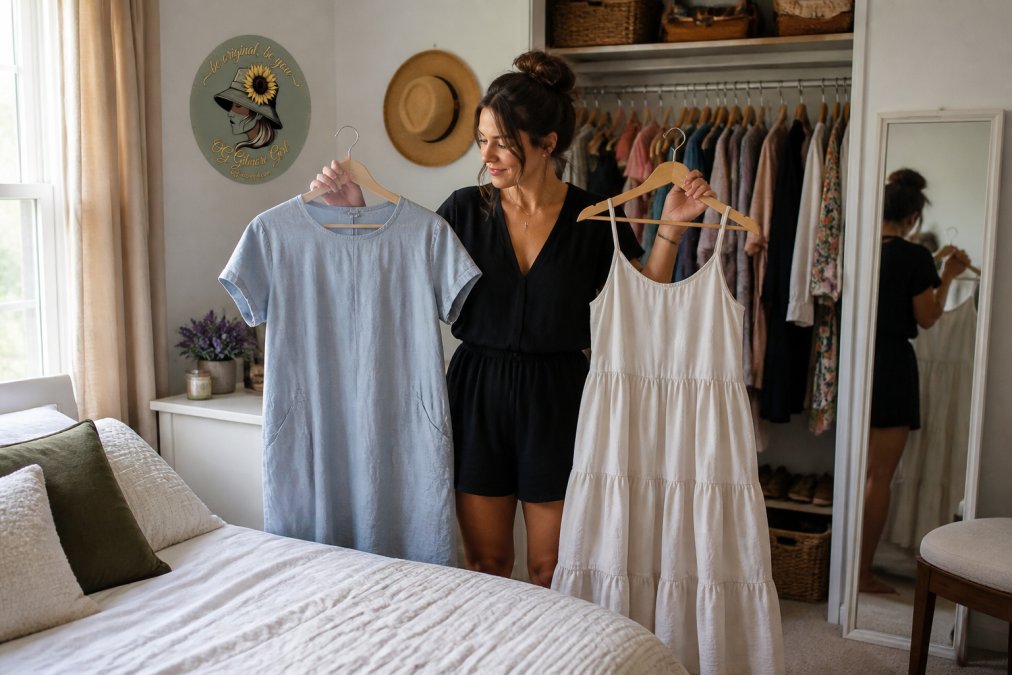
A woman in her late twenties standing in a bright bedroom, holding up two everyday dresses on hangers, one cotton shift and one tiered woven sundress, with a closet and mirror behind her
Cotton and cotton-rich blends handle daily wear best because they breathe, wash well, and hold up to repeat laundering. Jersey knit cotton is the most comfortable for all-day wear, while a 50/50 cotton-poly blend resists wrinkles and pilling better. Linen and rayon work for warm weather but crease more, so they suit days when you don't mind a relaxed, rumpled look. Pick based on your climate and how often you want to iron.
Navy Loose Fit Dress
Denim Sundress
Lil’ Black Dress
Is cotton or polyester better for everyday dresses?
Cotton wins on breathability, moisture-wicking, and hand-feel, which matters if you run warm or wear dresses all day. Polyester wins on wrinkle resistance, colorfastness, and shape retention, and it costs less to produce. A blend of the two gets you most of both: a 50/50 cotton-poly like the Mixed Checkered Woven Babydoll Dress keeps the soft feel while cutting down on creasing and shrinkage.
Which fabrics are most breathable for daily wear?
Linen, cotton, rayon, and viscose top the list because their fiber structure lets air move through the weave. Look for lightweight, unlined woven fabrics and open weaves rather than tight knits. The Floral Tiered Sun Dress uses a lightweight unlined woven fabric that stays airy in heat, and the Navy Loose Fit Dress is unlined and lightweight with a loose shift silhouette that keeps airflow around the body.
How do I choose a fabric that doesn't wrinkle easily?
Wrinkle resistance comes from synthetic content and tight weave structure. Polyester, spandex blends, and polycotton hold their shape best, which is why the Sweet Striped Babydoll Dress (95% polyester, 5% spandex) and the Little Blue Leopard Dress (85% polyester, 15% spandex) stay smooth through a workday. Cotton and linen crease more, so if you want low-iron mornings, lean toward blends rather than 100% natural fibers.
How do I care for cotton and linen dresses so they last?
Wash cotton and linen in cold water on a gentle cycle and skip the dryer, or use low heat, since both fibers shrink with high temperatures. Turn dresses inside out to protect colorfastness and reduce pilling from friction. Hang linen slightly damp to let the weight of the fabric smooth creases, and store cotton folded rather than on thin hangers to avoid shoulder stretch. Treat stains quickly, before they set into the weave.
Picking the right fabric still takes a little practice, and the wrong fiber shows up fast after a few washes. OG Gilmore Girl takes the guesswork out with a curated selection of dresses built from breathable, wearable fabrics, plus 15% off your first order, free shipping over $100, and G-Bucks rewards on everything you buy. Get started with OG Gilmore Girl and build an everyday wardrobe that actually lasts.
Learn how to price clothing boutique items using markup formulas, cost calculations, and market research. Step-by-step pricing strategy for retail success.
Discover the best professional footwear to pair with shirt dresses. From ankle boots to flats, find comfortable office shoes that elevate your work style.
Discover the real benefits of investing in boutique clothing, from better quality to lower cost per wear. Learn how to spot well-made pieces that last.
Discover eco friendly loungewear brands for women that prioritize sustainable materials and ethical production. Shop comfortable, stylish options today.
Affordable matching lounge sets for petite women: Shop affordable matching lounge sets designed for petite women. Find cozy, stylish options with proper.
Casual vs cocktail dress codes explained: what to wear to each, key differences, and how to nail wedding guest attire. Get the guide and shop the look.
Discover the quiet luxury trend in 2026: timeless style, intentional consumption, and effortless elegance. Learn how to build your curated wardrobe today.
Dress up loungewear for work: Master the art of dressing up loungewear for work. Learn styling tricks, fabric choices, and layering techniques to look.
Learn how to style simple dresses for beginners with easy tips on accessories, layering, and capsule wardrobe essentials. Discover effortless looks today.
Learn how to mix and match different denim styles with confidence. Master washes, textures, and fits for a polished denim-on-denim look. Start styling.
Learn how to wear casual dresses to a wedding with confidence. Get styling tips, dress code guidance, and outfit ideas for every venue and season. Shop.
Dad jeans vs mom jeans: learn the real difference in rise, leg shape, and fit, plus styling tips for each. Find your perfect pair and shop with confidence.
Learn how to wear wide leg jeans for pear shape in 2026 with fit tips, styling tricks, and denim picks that balance hips and define your waist. Shop now.
Swap your jeans for casual dress alternatives that feel just as easy. Explore comfy pants, midi skirts, and dresses to refresh your everyday look. Shop.
Clothing sizes vary by brand due to vanity sizing, fit models, and no universal standards. Learn how to read size charts and measure yourself accurately.
Midi dress vs maxi dress for petite women: compare hemlines, silhouettes, and styling tricks to find the most flattering fit. Discover your perfect length.
Find spring dress alternatives to expensive designer styles for 2026. Shop affordable boutique picks that match runway trends without the luxury price tag.
Super cute and soft but so long on my 5ft frame and rip on inseam:(
Everything was done to make the issue right. A free return and refund was offered and declined. We offered to pay for the seamstress to fix the tear. A 40% discount was also given for a future purchase for the inconvenience.